Designing a Clean REST API with Node.js and Express
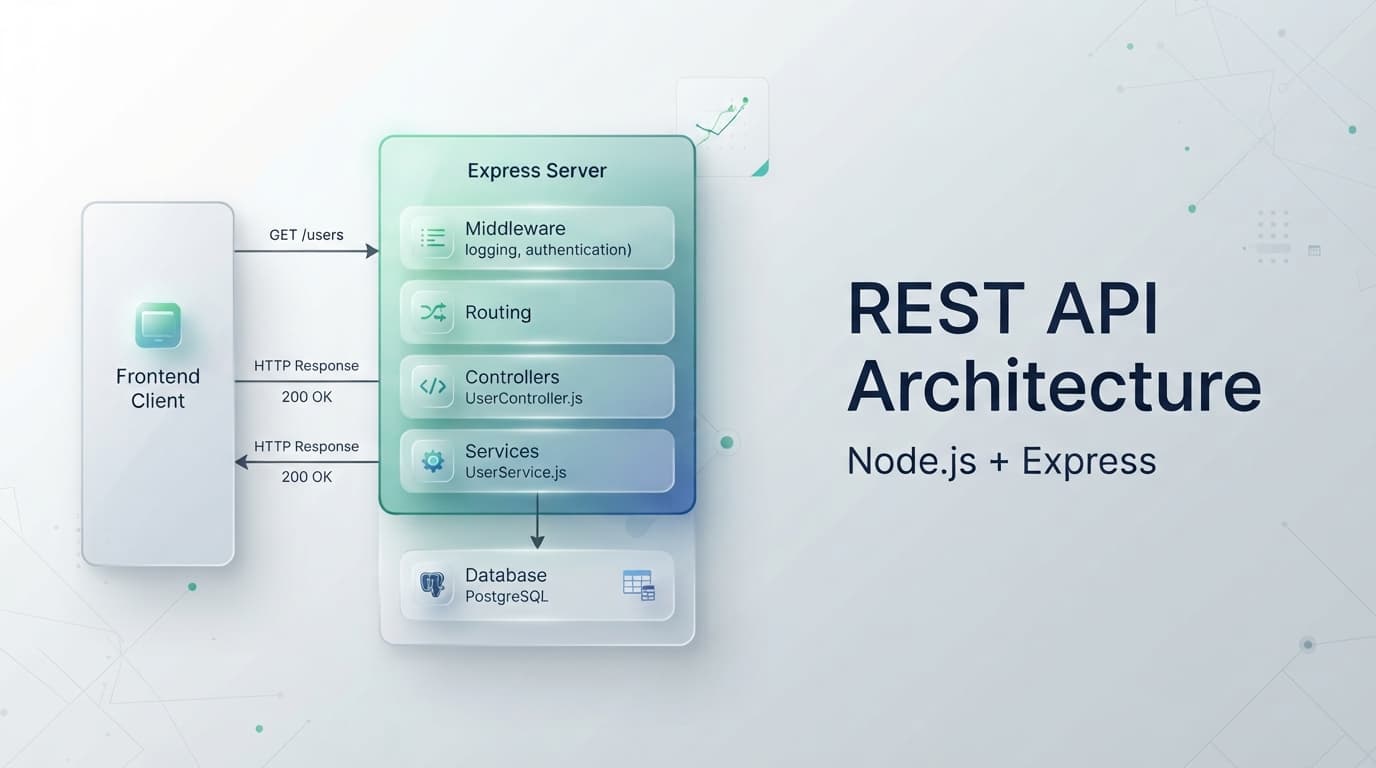
A well-designed API is one of the most important foundations of a modern web application. Whether the frontend is built with React, Next.js, Vue, or another framework, a clean backend API makes it easier to manage data, authentication, business logic, and communication between different parts of an application.
Node.js and Express provide a lightweight and flexible foundation for building REST APIs. However, simply creating endpoints is not enough. As an application grows, the backend needs a structure that keeps responsibilities separated and makes the codebase easier to maintain.
Understanding REST APIs
REST, or Representational State Transfer, is an architectural style commonly used for building web APIs.
A REST API exposes resources through HTTP endpoints. For example, a user resource might have endpoints such as:
GET /usersGET /users/:idPOST /usersPATCH /users/:idDELETE /users/:id
Each endpoint represents an operation on a resource.
Using consistent naming and HTTP methods makes an API easier for frontend developers and other consumers to understand.
Why Node.js and Express?
Node.js provides a JavaScript runtime that allows developers to build server-side applications using JavaScript or TypeScript.
Express adds a minimal web framework on top of Node.js and provides useful functionality for:
- Routing
- Middleware
- Request handling
- Response handling
- Error handling
- API organization
Its flexibility makes Express suitable for both small APIs and larger backend applications.
Organizing the Backend
A backend becomes difficult to maintain when all logic is placed inside route files.
A better approach is to separate responsibilities into layers.
A typical structure might look like:
Routes → Controllers → Services → Database
Routes define the API endpoints.
Controllers receive HTTP requests, validate basic request information, and return responses.
Services contain the application's business logic.
The database layer handles persistence and data access.
This structure prevents individual files from becoming unnecessarily large and makes the system easier to extend.
Middleware
Middleware is one of Express's most powerful features.
Middleware can be used for tasks such as:
- Authentication
- Authorization
- Request logging